
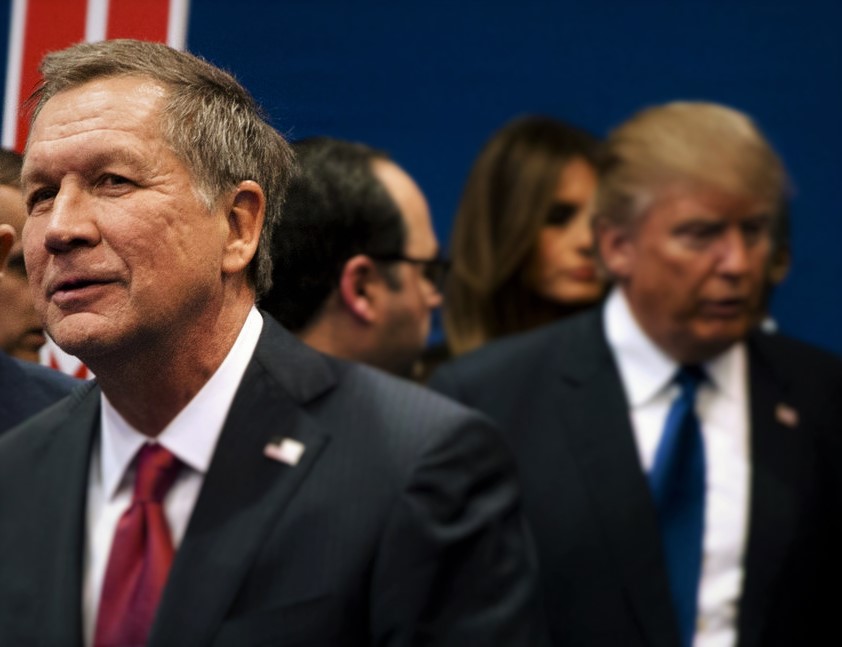
Gov. John Kasich (R-Ohio) moved his social conservative record more closely to the center today, vetoing a controversial “heartbeat” abortion bill that he once said he supported.
The “heartbeat bill” would have essentially outlawed abortion in Ohio and has been viewed as unconstitutional by Democrats and Ohio Right to Life alike.
During his first term Kasich told me that he viewed the “heartbeat bill” as “reasonable.”
But today he brought up its constitutionality in refusing to sign it.
Instead he signed a bill that bans abortion after 20 weeks of gestation except if the mother’s life is in danger.
It, too, may be unconstitutional, but not near as controversial as the “heartbeat bill.”
The bill marks the 18th time Kasich has signed an abortion restriction into law during his tenure as governor.
Some of them represent the most restrictive abortion laws in the country.
One banned all abortions after a fetus is deemed viable outside the womb.
Another required women to undergo an ultrasound and listen to the fetal heartbeat before an abortion.
An attempt by Kasich and his Republican allies at the statehouse to squeeze all abortion clinics in Ohio out of existence is working at a record pace, the number falling by half, from sixteen to eight, since 2011.
Kasich today also issued an executive order including “gender identity or expression” in Ohio’s anti-discrimination policy for state employees.
“Gender identity or expression” was added to a 2011 list of anti-discrimination statutes that already included race, color, religion, gender, national origin, military status, disability, age or sexual orientation.
“It’s just the right thing to do,” Kasich said on Twitter.
It’s just the right thing to do.
https://t.co/xQTWzRYsrO— John Kasich (@JohnKasich) December 19, 2018
This was a surprise to many on the right and the left, considering Kasich’s previous views on social issues.

Jim Obergefell and John Arthur, suffering from ALS, married in Maryland because Ohio didn’t allow same-sex marriage. Their case would lead to a historic Supreme Court decision.
Five years ago, when a federal court ordered Ohio to recognize Jim Obergefell as John Arthur’s surviving spouse on a death certificate, Kasich responded with little sympathy, “people of the state, including me, voted to say marriage should be between a man and a woman.”
He instructed Attorney General (now Gov-elect) Mike DeWine to aggressively fight the decision all the way to the U.S. Supreme Court.
Despite polls showing growing support in Ohio and across the country, and the endorsement from fellow Ohio Republicans Senator Rob Portman and former Attorney General Jim Petro, Kasich remained steadfast in his view.
When Ohio lost the case before the Supreme Court, resulting in marriage equality across the country, Kasich responded, “I’m obviously very disappointed
The Supreme Court decision was close: 5 to 4, with Justice Anthony Kennedy the deciding vote.
Like the ruling on interracial marriage announced by the court in 1967, most younger Americans, more socially liberal than their parents and grandparents, were pleased and anxious to move on.
“We started this fight for each other, and I’ve completed it for him and for our marriage,” Obergefell said following the ruling.
When history looks back and examines marriage equality in America, Obergefell and the state of Ohio will be key players and Kasich and DeWine will be on the wrong side of it.
On guns, Kasich has a mixed public record.
In 2010, the NRA and Buckeyes Firearm Association endorsed his opponent Gov. Ted Strickland, because in Congress Kasich had dared vote for the ban on assault-weapons.
But in his eight years as governor, Kasich stood firmly by the NRA’s side.
He signed laws legalizing concealed weapons in bars and restaurants, allowing people to bring guns into the parking garages under the statehouse, allowing Ohioans to use silencers while hunting, and reducing required training time for a concealed-carry license.
In fact, there were so many proposed gun laws—most rolling back regulations—that Ken Hanson, the legal chairman of the Buckeye Firearms Foundation, matter-of-factly told me, “Sometimes at the statehouse it’s an embarrassment of riches.”
Yet, today, as he looks at a possible primary challenge to President Trump in 2020, Kasich again took on the NRA and vetoed a bill intended to expand gun-owner rights by bolstering their legal defenses.
“This has never been the law in Ohio; the defendant has always had the burden of proving self-defense. This provision of the bill is strongly opposed by the Ohio Prosecuting Attorneys Association,” Kasich wrote in his veto message.
While, Kasich did applaud certain merits in the bill, including strengthening penalties against illegal “strawman” gun purchases and allowing off-duty police officers to carry concealed weapons.
State lawmakers plan to re-convene next week and could try to override the veto.
What is clear from all three vetoes today is that John Kasich is leaving office is a lot more mavericky than the candidate who eight years ago proclaimed he was the “in the tea party before there was a tea party.”