
America’s deadliest day from the coronavirus pandemic is estimated to hit in two weeks with more than 2,000 deaths, according to data analysis that predicts the crisis will stretch into June.
The death toll from the coronavirus is predicted to rise to 2,271 on April 15 alone, the model analysis by the University of Washington School of Medicine shows.
The analysis, which uses data from governments, hospitals and other sources, predicts that the number of deaths will then start decreasing slowly after April 15.
Deaths per day will only drop to below 100 after June 9, according to the analysis.
Some people could continue to die of the virus as late as July, although deaths should be below epidemic levels of 10 per day by the first week of July at the latest, according to the analysis.
Dr Anthony Fauci, the government’s top infectious disease expert, said on Sunday that the US could experience between 100,000 to 200,000 deaths and millions of infections from the pandemic.
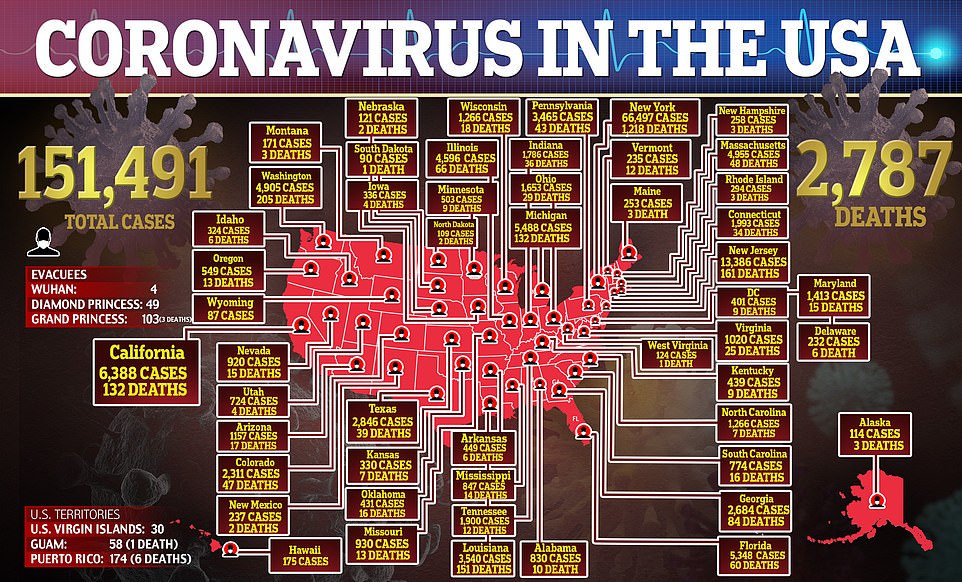
As of today, the US had more than 150,000 confirmed cases and more than 2,700 deaths.
In New York state, the epicenter of the virus, there now more than 66,000 cases of the virus and 1,218 people have died.
The analysis also highlights the strain that will be placed on hospitals with the number of hospitalized patients expected to peak nationally by the second week of April – although the peak may come later in some states.
The analysis predicts that the number of US deaths could vary widely, ranging from as low as around 38,000 to as high as around 162,000, due in part to disparate rates of the spread of the virus in different regions.
If social distancing is adhered to, the number of deaths from coronavirus is predicted to reach about 82,000 over the next four months, the analysis predicts.
The Federal Emergency Management Agency (FEMA) is sending refrigerator trucks to New York City to act as interim mortuaries for those who died from COVID-19, an official said Monday.
Thomas Von Essen, FEMA’s regional administrator, made the announcement during a press conference with New York City Mayor Bill de Blasio and said the agency has provided 42 people to help in the Manhattan Medical Examiner’s Office.
“We are sending refrigeration trucks to New York to help with some of the problem on a temporary basis,” he said.
Local officials greeted the Naval medical ship the USNS Comfort to the city to alleviate the pressure on city hospitals.
De Blasio said New York City is readying for a “horrible increase” in the death totals from the pandemic.
“To date, I still fear the worse is not going to be April but actually the beginning of May,” de Blasio said. “I guarantee you that April is going to be exceedingly tough and we have to understand that any projection of things being all OK by Easter, there’s just no way that’s true for New York City.”
Bracing the nation for a coronavirus death toll that could exceed 100,000 people, President Trump extended national restrictive social distancing guidelines through April.
The initial 15 day period of social distancing urged by the federal government expired today and Trump had expressed interest in relaxing the national guidelines at least in parts of the country less afflicted by the pandemic.
He instead on Sunday said he was extending them through April 30, bowing to public health experts who presented him with even more dire projections for the expanding coronavirus pandemic.
Trump’s impulse to reopen the country met a sober reality check from Dr Fauci.
Brought forward by Trump at the outdoor briefing, Fauci said his projection of a potential 100,000 to 200,000 deaths is ‘entirely conceivable’ if not enough is done to mitigate the crisis.
‘It would not have been a good idea to pull back at a time when you really need to be pressing your foot on the pedal as opposed to on the brakes,’ Fauci said, describing how he and others had convinced Trump to extend the restrictions.
‘We showed him the data. He looked at the data. He got it right away,’ Fauci said. ‘It was a pretty clear picture. Dr Debbie Birx and I went in to the Oval Office and leaned over the desk and said, ‘Here are the data. Take a look.’ He just shook his head and said, ‘I guess we got to do it’.’
Americans are now being called on to prepare for another 30 days of severe economic and social disruption, as schools and businesses are closed and public life is upended.
One in three Americans remain under state or local government orders to stay at home to slow the spread of the virus.
Trump acknowledged that he may be forced to extend the guidelines again at the end of April, but expressed hope that the country would be ‘well on our way to recovery’ by June 1.