
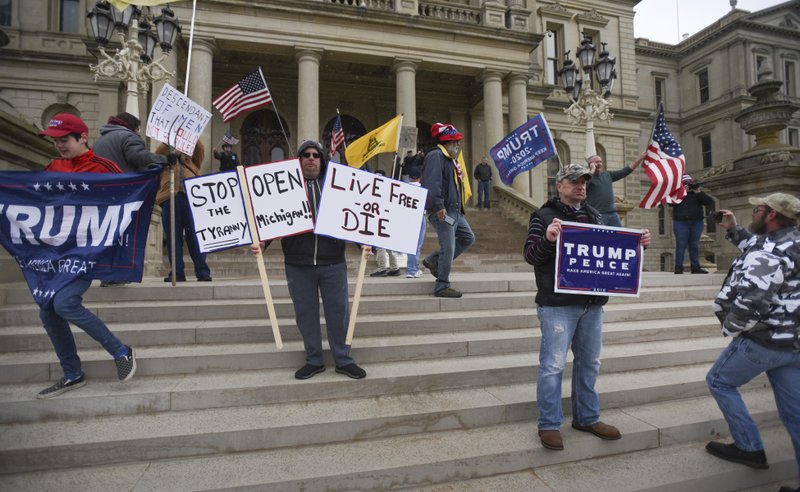
President Trump today openly encouraged right-wing protests of social distancing restrictions in states with stay-at-home orders, a day after announcing guidelines for how the nation’s governors should carry out an orderly reopening of their communities on their own timetables.
In a series of all-caps tweets that started two minutes after a Fox News report on the protesters, the president declared, “LIBERATE MICHIGAN!” and “LIBERATE MINNESOTA!” — two states whose Democratic governors have imposed strict social distancing restrictions.
He also lashed out at Virginia, where the state’s Democratic governor and legislature have pushed for strict gun control measures, saying: “LIBERATE VIRGINIA, and save your great 2nd Amendment. It is under siege!”
His stark departure from the more bipartisan tone of his announcement on Thursday night suggested Trump was ceding any semblance of national leadership on the pandemic, and choosing instead to divide the country by playing to his political base.
Vice President Mike Pence, meanwhile, encouraged Americans at an afternoon briefing to continue to social-distance.
Earlier, on a phone call between Pence and Senate Democrats, Senator Tim Kaine of Virginia asked why Trump was trying to incite division in the middle of pandemic, in reference to Trump’s tweets.
When Pence said that the administration was working respectfully with governors, Kaine noted that the tweets were not respectful.
An administration official familiar with the phone call described it as far more heated than a similar one last week, and noted that the call included representatives from the Federal Emergency Management Agency, Dr. Anthony S. Fauci and Dr. Deborah L. Birx.
The official said that when Kaine asked about Trump’s tweets, Pence said that Trump was an effective communicator and was not going to stop talking to the American people.
Echoed across the internet and on cable television by conservative pundits and ultraright conspiracy theorists, Trump’s tweets were a remarkable example of a president egging on demonstrators and helping to stoke an angry fervor that in its anti-government rhetoric was eerily reminiscent of the birth of the Tea Party movement a decade ago.
Trump’s call for liberation from social distancing rules followed protests around the country as protesters — many wearing red “Make America Great Again” hats — congregated in packed groups around state capitols to demand that restrictions be immediately lifted and to demonize their Democratic governors.
In Michigan, protesters waved banners in support of Trump and protested Gov. Gretchen Whitmer by chanting, “Lock her up.”
In St. Paul, Minn., a group calling itself “Liberate Minnesota” rallied against stay-at-home orders in front of the home of Gov. Tim Walz.
In Columbus, Ohio, protesters crowded closely together as they pressed up against the doors of the state’s Capitol.
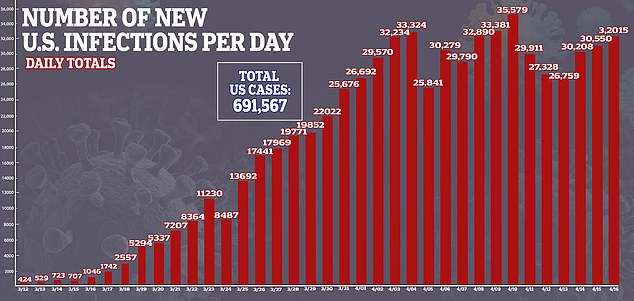
Gov. Jay Inslee of Washington said Trump’s tweets “encourage illegal and dangerous acts” and said the president was “putting millions of people in danger of contracting Covid-19.”
Inslee added: “His unhinged rantings and calls for people to ‘liberate’ states could also lead to violence. We’ve seen it before.”
And in Michigan, Whitmer said she hoped the president’s comments would not incite more protests.
“The most important thing that anyone with a platform can do is try to use that platform to tell people, ‘We are going to get through this,’” she said.
And when Gov. Ralph Northam of Virginia was asked about the president’s comment at a virus news briefing Friday, he said: “I do not have time to involve myself in Twitter wars.”
The United States is struggling to test enough people to track and control the spread of the novel coronavirus, a crucial first step to reopening parts of the economy, which Trump is pushing to do by May 1.
More than a month after Trump declared, “Anybody who wants a test, can get a test,” the reality has been much different.
People report being unable to get tested.
Labs and public officials say critical supply shortages are making it impossible to increase testing to the levels experts say is necessary to keep the virus in check.
“There are places that have enough test swabs, but not enough workers to administer them. There are places that are limiting tests because of the CDC criteria on who should get tested,” said Dr. Megan Ranney, an emergency physician and associate professor at Brown University. “There’s just so many inefficiencies and problems with the way that testing currently happens across this country.”