President Trump ignored advice by the National Security Council back in January to consider shutting down cities and keep Americans home from work, memos reveals.
“Any way you cut it, this is going to be bad,” a senior medical adviser at the Department of Veterans Affairs, Dr. Carter Mecher, wrote on the night of Jan. 28, in an email to a group of public health experts scattered around the government and universities. “The projected size of the outbreak already seems hard to believe.”
A week after the first coronavirus case had been identified in the United States, and six long weeks before President Trump finally took aggressive action to confront the danger the nation was facing — a pandemic that is now forecast to take tens of thousands of American lives — Mecher was urging the upper ranks of the nation’s public health bureaucracy to wake up and prepare for the possibility of far more drastic action.
Trump, though, was slow to absorb the scale of the risk and to act accordingly, focusing instead on controlling the message, protecting gains in the economy and batting away warnings from senior officials. It was a problem, he said, that had come out of nowhere and could not have been foreseen.
Even after Trump took his first concrete action at the end of January — limiting travel from China — public health often had to compete with economic and political considerations in internal debates, slowing the path toward belated decisions to seek more money from Congress, obtain necessary supplies, address shortfalls in testing and ultimately move to keep much of the nation at home.
Unfolding as it did in the wake of his impeachment by the House and in the midst of his Senate trial, Trump’s response was colored by his suspicion of and disdain for what he viewed as the “Deep State” — the very people in his government whose expertise and long experience might have guided him more quickly toward steps that would slow the virus, and likely save lives.
Decision-making was also complicated by a long-running dispute inside the administration over how to deal with China.
The virus at first took a back seat to a desire not to upset Beijing during trade talks, but later the impulse to score points against Beijing left the world’s two leading powers further divided as they confronted one of the first truly global threats of the 21st century.
The shortcomings of Trump’s performance have played out with remarkable transparency as part of his daily effort to dominate television screens and the national conversation.
But dozens of interviews with current and former officials and a review of emails and other records revealed many previously unreported details and a fuller picture of the roots and extent of his halting response as the deadly virus spread:
The National Security Council office responsible for tracking pandemics received intelligence reports in early January predicting the spread of the virus to the United States, and within weeks was raising options like keeping Americans home from work and shutting down cities the size of Chicago. Mr. Trump would avoid such steps until March.
Despite Trump’s denial weeks later, he was told at the time about a Jan. 29 memo produced by his trade adviser, Peter Navarro, laying out in striking detail the potential risks of a coronavirus pandemic: as many as half a million deaths and trillions of dollars in economic losses.
The health and human services secretary, Alex Azar, directly warned Trump of the possibility of a pandemic during a call on Jan. 30, the second warning he delivered to the president about the virus in two weeks.
Trump, who was on Air Force One while traveling for appearances in the Midwest, responded that Azar was being alarmist.
Azar publicly announced in February that the government was establishing a “surveillance” system in five American cities to measure the spread of the virus and enable experts to project the next hot spots.
It was delayed for weeks.
The slow start of that plan, on top of the well-documented failures to develop the nation’s testing capacity, left administration officials with almost no insight into how rapidly the virus was spreading.
“We were flying the plane with no instruments,” one official said.
By the third week in February, the administration’s top public health experts concluded they should recommend to Trump a new approach that would include warning the American people of the risks and urging steps like social distancing and staying home from work.
But the White House focused instead on messaging and crucial additional weeks went by before their views were reluctantly accepted by the president — time when the virus spread largely unimpeded.
When Trump finally agreed in mid-March to recommend social distancing across the country, effectively bringing much of the economy to a halt, he seemed shellshocked and deflated to some of his closest associates.
One described him as “subdued” and “baffled” by how the crisis had played out.
An economy that he had wagered his re-election on was suddenly in shambles.
He only regained his swagger, the associate said, from conducting his daily White House briefings, at which he often seeks to rewrite the history of the past several months.
He declared at one point that he “felt it was a pandemic long before it was called a pandemic,” and insisted at another that he had to be a “cheerleader for the country,” as if that explained why he failed to prepare the public for what was coming.
The final days of February, perhaps more than any other moment during his tenure in the White House, illustrated Trump’s inability or unwillingness to absorb warnings coming at him.
He instead reverted to his traditional political playbook in the midst of a public health calamity, squandering vital time as the coronavirus spread silently across the country.
Trump denied his administration was slow to react in a tweet this afternoon, calling the New York Times “fake news.”
Meanwhile, a new analysis of nationwide cell phone location data suggests that counties which voted for Trump in higher proportions are less likely to practice social distancing measures to limit the spread of the coronavirus pandemic.
The analysis, by Princeton sociologist Patrick Sharkey for Vox, also found that attitudes toward climate change are ‘one of the strongest and most robust predictors of social distancing behavior.’
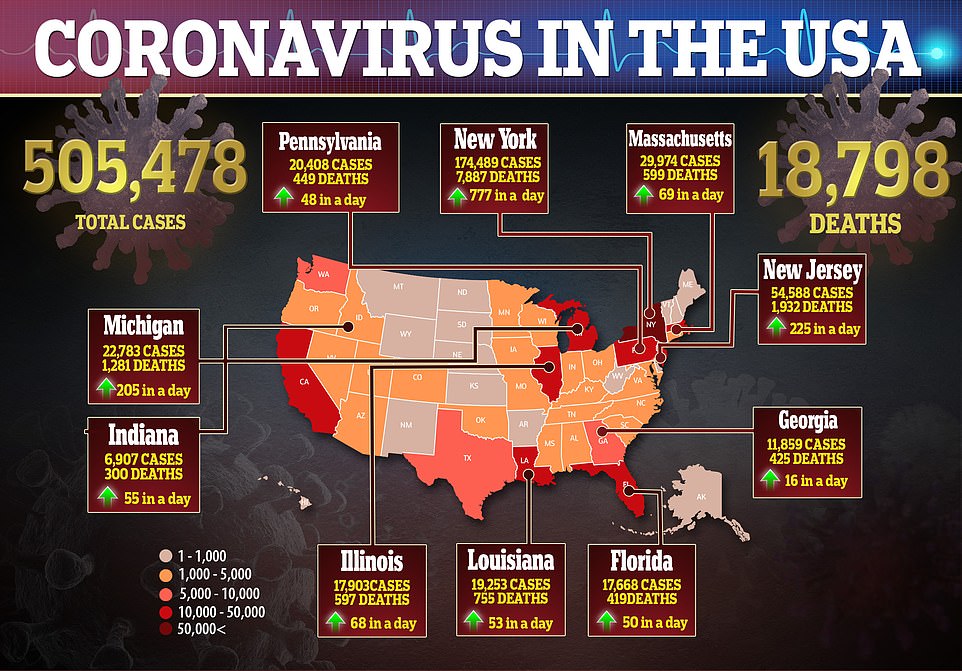
In parts of the country, a recalcitrant minority of people continue to openly blow off stay-at-home orders, defiantly congregating for recreational events in the midst of the pandemic that has infected more than 500,000 Americans and killed at least 18,798.
According to Sharkey’s analysis of location data, ‘politics and civic engagement bear a strong relationship to social distancing behavior.’
As the crisis continues, cell phone location data is coming to the forefront as a key tool in the battle — raising privacy concerns and exposing just how much data is being collected on Americans by private advertising and technology companies.
On Friday, Apple and Google announced a joint effort to help public health agencies worldwide use smartphone data to contain the COVID-19 pandemic.