
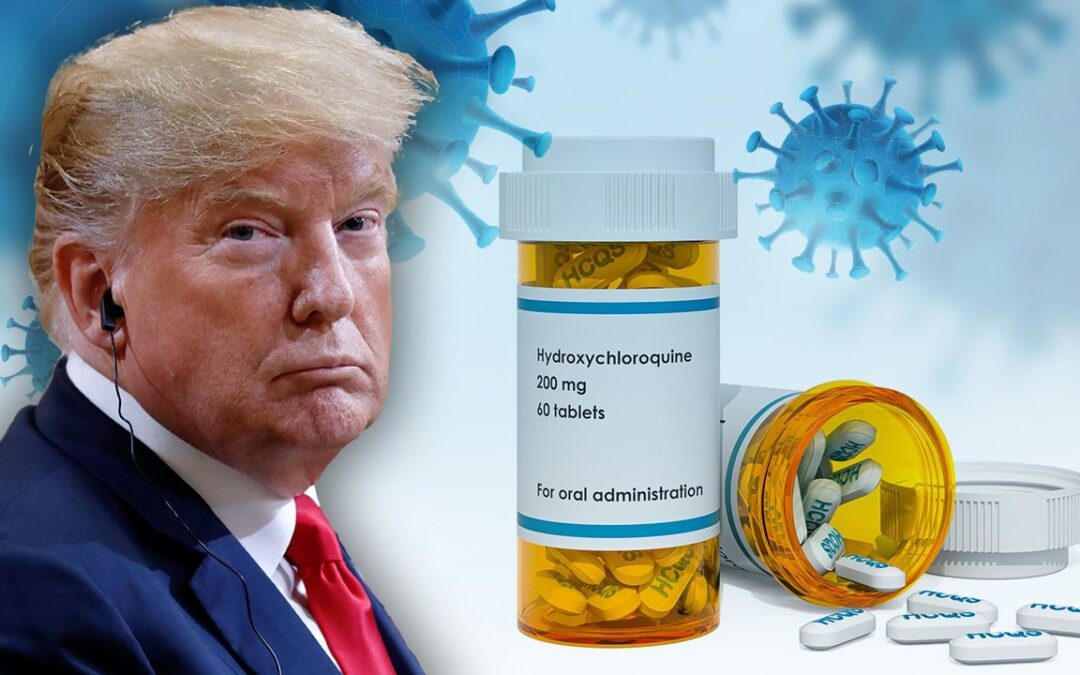
An anti-malaria drug backed by Donald Trump is not an effective Covid-19 treatment and raises the risk of death, a major study has today revealed.
In a massive blow to hopes of finding a cure and stopping the disease in its tracks, scientists found hydroxychloroquine offered ‘absolutely no benefit’.
Branded a ‘game-changer’ by Trump, he admitted he is taking the drug to protect himself from catching the infection.
Now research of nearly 100,000 Covid-19 patients, published in prestigious medical journal The Lancet, has cast further doubt over the drug’s efficacy.
As well as uncovering hydroxychloroquine had no benefit for coronavirus patients, results showed it raised the risk of death by up to 45 percent.
And Covid-19 patients taking the drug were up to five times more likely to develop a life-threatening arrhythmia – a known complication.
Pharmaceutical giant AstraZeneca has agreed to mass-manufacture the vaccine, in hope that millions of doses could be ready for September.
The US government – which has invested $ 1billion in the project – has ordered 300million doses, while Britain has a deal for 100 million.
Leading scientists today described the study – the latest in a string of research that has uncovered risks – as one of the ‘better ones’.
Experts at Brigham and Women’s Hospital in Boston, Massachusetts, analyzed data from 96,032 hospitalized Covid-19 patients spanning six continents.
Around 5,000 of the infected were either given hydroxychloroquine or its derivative chloroquine.
Another 10,000 were given hydroxychloroquine or chloroquine alongside two other promising drugs, antibiotics azithromycin or clarithromycin.
Data from those four groups was then compared against a control sample of 81,000 Covid-19 patients, who were given other medications.
Analysis showed one in 11 patients in the control group died in hospital – at a rate of 9.3 per cent.
In comparison, 18 percent of patients given hydroxychloroquine succumbed to the illness.
The rate was 16 percent among the chloroquine group.
When the two drugs were used in combination with one of the antibiotics, the death rate rose to almost a quarter of patients (23.8 percent).
Researchers cautioned that some of the difference in the rates of mortality was due to underlying differences between which patients received the treatment.
Many of the sickest patients – whose risk of dying is higher – are given the drugs as a last-ditch resort.
But when other factors known to raise the risk of death were included – such as age, race, BMI and co-morbidities – the drugs still increased the risk of dying by between 34 and 45 percent.
Lead author Dr Mandeep Mehra said: ‘This is the first large scale study to find statistically robust evidence that treatment with chloroquine or hydroxychloroquine does not benefit patients with Covid-19.
‘Instead, our findings suggest it may be associated with an increased risk of serious heart problems and increased risk of death.
‘Randomized clinical trials are essential to confirm any harms or benefits associated with these agents.
‘In the meantime, we suggest these drugs should not be used as treatments for Covid-19 outside of clinical trials.’
The study adds to past research that showed taking hydroxychloroquine could raise the risk of someone developing an abnormal heartbeat.
Scientists in the US and France last month found 90 percent of critically-ill COVID-19 patients given hydroxychloroquine developed heart arrhythmias.
An arrhytmia is an abnormal heartbeat rhythm in which the heart beats too slow, too fast or irregularly.
It is relatively common, affecting around two million people per year in the UK, but can increase the risk of life-threatening events such as stroke or cardiac arrest.
Massachusetts General Hospital researchers monitored 90 patients in intensive care units, while University of Lyon academics analyzed 40 patients.
Both uncovered similar results in JAMA Cardiology, after looking at the QT intervals – the time between the heart’s ventricular muscles contracting and then relaxing.
When this interval becomes too long, the patient has developed a dangerous form of heart arrhythmia, called atrial fibrillation.
Responding to today’s study by Brigham and Women’s Hospital, Professor Babak Javid, a consultant in infectious diseases at Cambridge University Hospitals, said the drugs had ‘absolutely no benefit’.
He added: ‘It (the study) certainly casts a great deal of doubt whether these agents are effective in the setting in which they are currently being used.’
Trump sparked fury earlier this week when announced he was taking the drug as a prophylaxis, despite there being no proof it works in this way.