
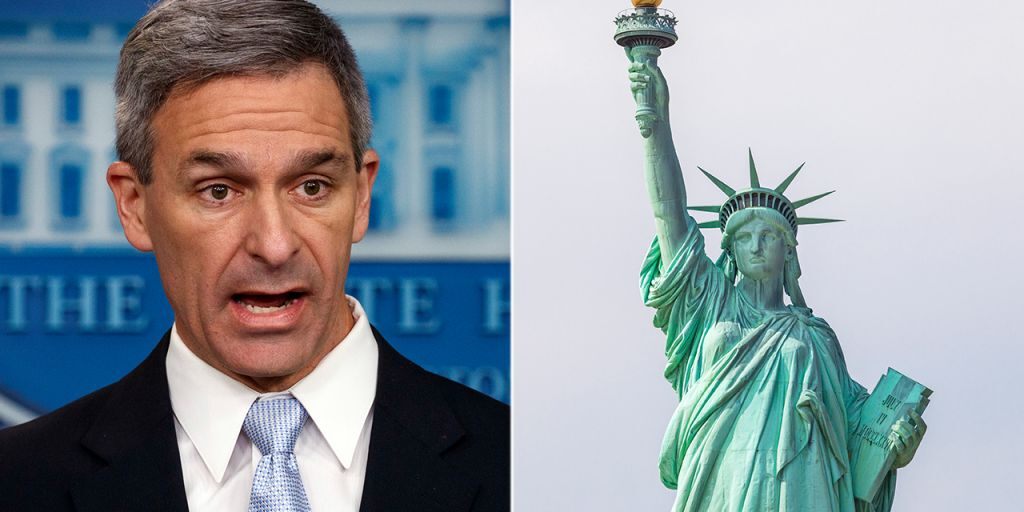
President Trump’s top immigration official today offered a revised version of the poem long displayed inside the Statue of Liberty’s pedestal that aligns more closely with the administration’s latest rule aimed at curbing the number of people who enter the United States legally.
Ken Cuccinelli, acting director of U.S. Citizenship and Immigration Services, was asked by NPR whether the words of Emma Lazarus’ “The New Colossus,” inscribed on a bronze tablet exhibited in the museum at the statue’s base, remain “part of the American ethos.”
“They certainly are,” Cuccinelli said. “Give me your tired and your poor — who can stand on their own two feet and who will not become a public charge.”
Cuccinelli’s comments come after the administration announced Monday a “public charge” regulation allowing federal officials to deny green cards to legal immigrants who have received certain public benefits or who are deemed likely to do so in the future.
Critics of the policy have argued it is at odds with Lazarus’ work, which reads in part: “Give me your tired, your poor, / Your huddled masses yearning to breathe free, / The wretched refuse of your teeming shore. / Send these, the homeless, tempest-tost to me, / I lift my lamp beside the golden door!”
The sonnet, associated with the torch-wielding lady who for decades greeted immigrants arriving in New York at Ellis Island, has long been interpreted as a message of welcome for those seeking refuge in the U.S.
Despite having zero actual experience in immigration policy, Cuccinelli was hired in May thanks to previous work sponsoring bills that tried to repeal birthright citizenship and would force employees to speak English in the workplace.
This isn’t the first time a member of the Trump administration has cast aspersions on the whole “give me your tired, your poor,” business.
Back in 2017, Stephen Miller, the president’s chief white rage officer, told Jim Acosta that he didn’t give a shit about the poem because it “was added later and is not part of the original Statue of Liberty.”
Lazarus’ poem, “The New Colossus,” was written in 1883, and a plaque with her words was not cast on the Statue of Liberty until 1903.