
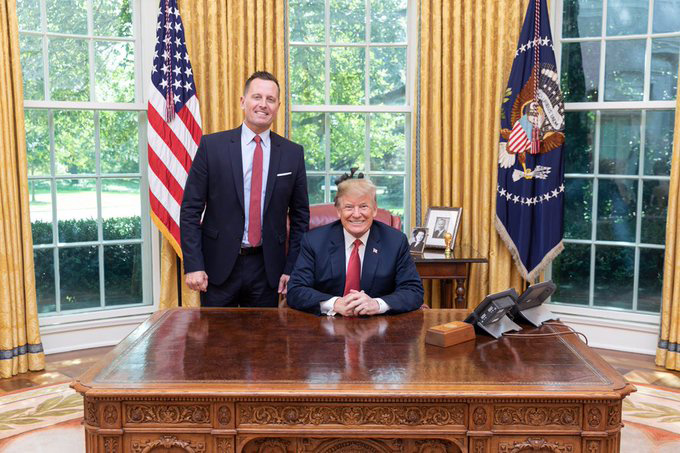
President Trump is expected to name Richard Grenell, the American ambassador to Germany, to be the acting director of national intelligence.
Grenell, whose outspokenness throughout his career as a political operative and then as ambassador has prompted criticism, is a vocal Trump loyalist who will lead a group of national security agencies often viewed skeptically by the White House.
He would take over from Joseph Maguire, who has served as the acting director of national intelligence since the resignation last summer of Dan Coats, a former Republican senator from Indiana.
Grenell, who has pushed to advance gay rights in his current post, would apparently also be the first openly gay cabinet member.
Under law, Maguire had to give up his temporary role before March 12.
He could return to his old job as director of the National Counterterrorism Center, but he might choose to step down from government.
Trump can choose any Senate-confirmed official to replace Maguire as the acting head of the nation’s 17 intelligence agencies.
Maguire, a retired admiral, became the acting director in August just as a whistle-blower inside the C.I.A. filed a complaint about Trump’s dealings with Ukraine.
Since the acquittal of Trump in the Senate impeachment trial, the White House has been pushing to remove officials seen as disloyal or holding views contrary to the White House, looking for replacements who are more likely to follow the president’s wishes.
While it has never been clear how Trump viewed Mr. Maguire, there is little doubt that the president would like a partisan fighter in the post before any public testimony before Congress.
Grenell has long been ambitious and has been anxious for a promotion from his diplomatic post.
But Grenell is also a polarizing figure and his confirmation by the Senate is not assured, one reason the president intends to name him acting director, rather than formally nominating him for the job.
A number of Republican senators have privately pushed the administration to nominate a national security professional or politician who is seen as a less divisive figure.
Since the beginning of his administration, Trump has viewed the intelligence agencies skeptically.
He has at times disparaged American intelligence agencies because he did not agree with their findings, such as the conclusion that Russia interfered with the 2016 presidential election in an effort to help Trump win.
He told his intelligence chiefs to “go back to school” after they offered assessments on Iran and North Korea at odds with his policy initiatives.
Coats announced his resignation in July, effective Aug. 15. Including acting directors, nine people have served as head of the Office of the Director of National Intelligence since the job was created in late 2004 to improve the nation’s ability to fight terrorism.
That law made the director of national intelligence the top intelligence adviser to the president.
When Coats announced his resignation, Trump initially nominated one of his loyalists, Representative John Ratcliffe, Republican of Texas, to be the next top intelligence chief, a job considered to be among the most nonpartisan in Washington.
But Trump quickly dropped those plans after pushback from Democrats and some key Republicans who worried Ratcliffe’s loyalty to the president and lack of intelligence experience would make him nearly impossible to confirm.