
JimHeath.TV has received several requests from readers this week to offer an easy-to-understand explanation of what the coronavirus is, and what to do to prevent it.
We have pulled together the answers from medical experts interviewed by credentialed news agencies around the world.
Let’s start at the beginning.
How worried should I be?
You should be concerned and take this seriously. But you should not panic. This is not a media or liberal hoax, as suggested at first by President Trump. This coronavirus is unquestionably dangerous. It causes a disease called COVID-19, which can be deadly, particularly for older people and those with underlying health conditions.
What is Covid-19 – the illness that started in Wuhan?
It is caused by a member of the coronavirus family that has never been encountered before. Like other coronaviruses, it has come from animals. Many of those initially infected either worked or frequently shopped in the Huanan seafood wholesale market in the centre of the Chinese city.
What are the symptoms this coronavirus causes?
COVID-19 is a disease with a range of symptoms and severities, and we are still learning about the full spectrum. So far, it seems to span from mild or potentially asymptomatic cases all the way to moderate pneumonia, severe pneumonia, respiratory distress, organ failure and, for some, death.
Many cases start out with fever, fatigue and mild respiratory symptoms, like a dry cough. Most cases don’t get much worse, but some do progress into a serious illness.
According to data from nearly 56,000 laboratory-confirmed COVID-19 patients in China, the rundown of common symptoms went as follows:
- 88 percent had a fever
- 68 percent had a dry cough
- 38 percent had fatigue
- 33 percent coughed up phlegm
- 19 percent had shortness of breath
- 15 percent had joint or muscle pain
- 14 percent had a sore throat
- 14 percent headache
- 11 percent had chills
- 5 percent had nausea or vomiting
- 5 percent had nasal congestion
- 4 percent had diarrhea
- Less than one percent coughed up blood or blood-stained mucus
- Less than one percent had watery eyes
The virus can cause pneumonia. Those who have fallen ill are reported to suffer coughs, fever and breathing difficulties. In severe cases there can be organ failure. As this is viral pneumonia, antibiotics are of no use. The antiviral drugs we have against flu will not work. Recovery depends on the strength of the immune system. Many of those who have died were already in poor health.
Should I go to the doctor if I have a cough?
The medical advice is that if you have recently traveled from areas affected by coronavirus, you should: Stay indoors and avoid contact with other people as you would with the flu. Call local health officials to inform them of your recent travel to the area.
If you believe you have COVID-19, the CDC advises you should call your healthcare provider—do not make an unannounced office visit. Your healthcare provider, with the help of your state’s health department and the CDC, can determine if you should come in and get tested.
Is the virus being transmitted from one person to another?
Yes. China’s national health commission has confirmed human-to-human transmission, and there have been such transmissions elsewhere.
How many people have been affected?
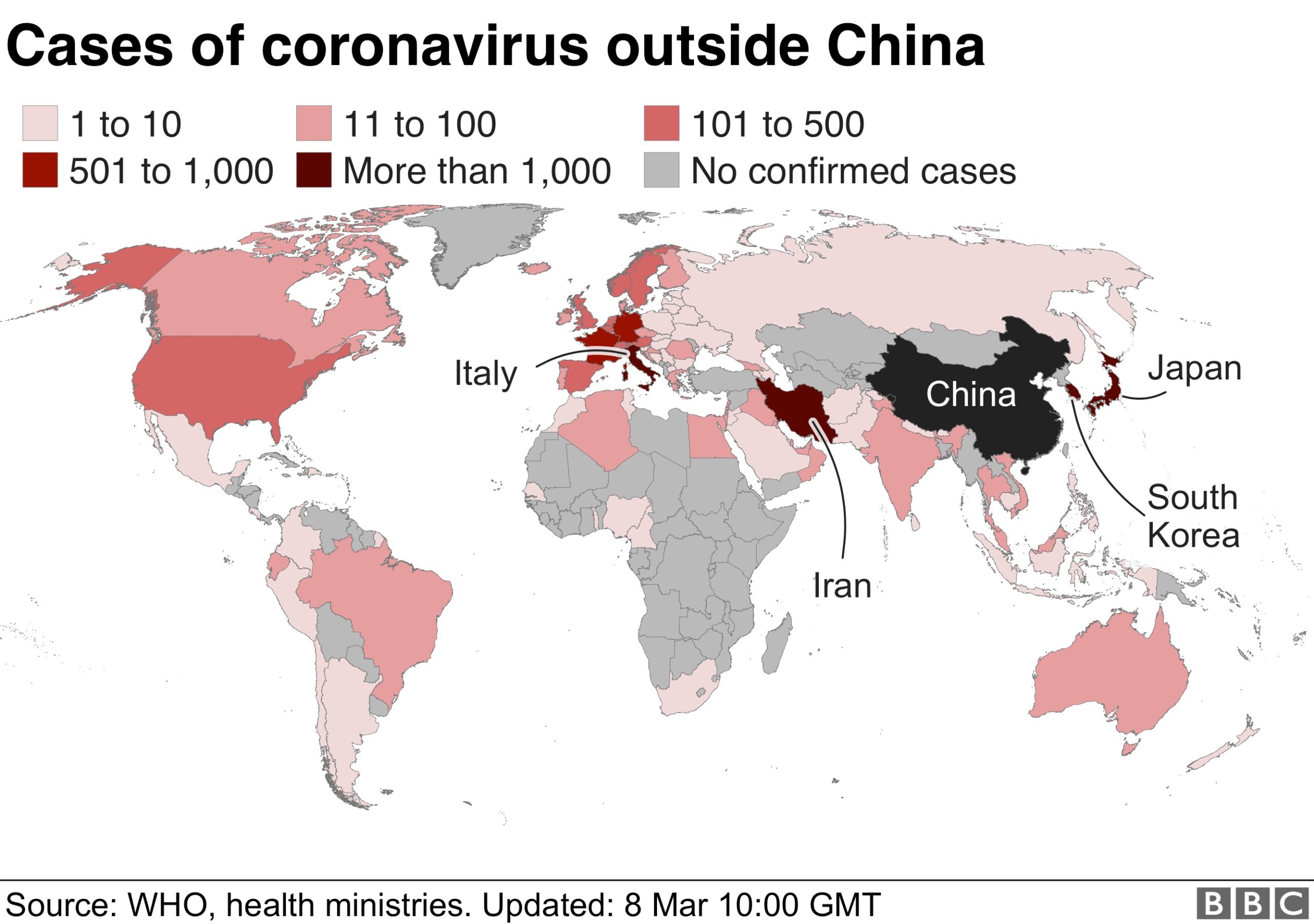
As of March 6, the global death toll was 3,404, while more than 100,000 people have been infected in more than 80 countries, according to the Johns Hopkins University Center for Systems Science and Engineering.
The death toll has passed 3,000 in China, where there have been over 80,000 cases. South Korea, the nation worst hit by the outbreak outside China, has had 6,593 cases. More than 55,000 people in China have recovered from Covid-19.
Why is this worse than normal influenza, and how worried are the experts?
We don’t yet know how dangerous the new coronavirus is, and we won’t know until more data comes in. The mortality rate is around 2% in the epicentre of the outbreak, Hubei province, and less than that elsewhere. For comparison, seasonal flu typically has a mortality rate below 1% and is thought to cause about 400,000 deaths each year globally. Sars had a death rate of more than 10%.
Another key unknown is how contagious the coronavirus is. A crucial difference is that unlike flu, there is no vaccine for the new coronavirus, which means it is more difficult for vulnerable members of the population – elderly people or those with existing respiratory or immune problems – to protect themselves. Hand-washing and avoiding other people if you feel unwell are important. One sensible step is to get the flu vaccine, which will reduce the burden on health services if the outbreak turns into a wider epidemic.
Have there been other coronaviruses?
Severe acute respiratory syndrome (Sars) and Middle Eastern respiratory syndrome (Mers) are both caused by coronaviruses that came from animals. In 2002, Sars spread virtually unchecked to 37 countries, causing global panic, infecting more than 8,000 people and killing more than 750. Mers appears to be less easily passed from human to human, but has greater lethality, killing 35% of about 2,500 people who have been infected.
How long does COVID-19 last?
On average, it takes five to six days from the day you are infected with SARS-CoV-2 until you develop symptoms of COVID-19. This pre-symptomatic period—also known as “incubation”—can range from one to 14 days. From there, those with mild disease tend to recover in about two weeks, while those with more severe cases can take three to six weeks to recover. Most people infected will have a mild illness and recover completely in two weeks.
Should I avoid large gatherings and travel?
Unfortunately, there is no clear or general answer to this. Like your risk of exposure generally, risk from attending events and traveling depend on where you are and where you are going. Any time you’re faced with such a decision amid this epidemic, you should consider not only your local risk but also whether you will encounter people from high risk areas while traveling to the event or once you are at it. For local events largely attended by local people in communities where there are no or limited cases, attending is considered low risk. Traveling to or through areas experiencing large clusters of cases will certainly increase your risk of contracting COVID-19. Attending a conference where there will be groups of people from high-risk areas also increases your risk.
What are the problems with testing in the US?
Testing for COVID-19 in the US has been a tragic debacle.
The CDC was tasked with coming up with a diagnostic test to detect SARS-CoV-2 in respiratory samples from patients. The agency developed an RT-PCR test for the new virus and sent testing kits beginning in early February to states. But, as the agency notes on its website, “shortly thereafter performance issues were identified related to a problem in the manufacturing of one of the reagents which led to laboratories not being able to verify the test performance.”
While the CDC has been quiet about what exactly went wrong, a report in Science suggests that the problem was with a negative control in the kit—a sample designed to produce a negative test result. The problem took the agency weeks to resolve, and many states weren’t able to ramp up testing until the end of February and start of March. “This has not gone as smoothly as we would have liked,” Dr. Nancy Messonnier, director of the CDC’s National Center for Immunization and Respiratory Diseases, said in a press briefing February 28.
The testing snag cost the country precious time in detecting imported cases, isolating them, and tracing their contacts—critical steps needed to contain the virus. Now, in early March, things are improving. The CDC has worked out the problem with its tests, the FDA has loosened regulations on who can design their own tests, and commercial tests are coming online to provide additional kits to states.
When will all of this be over in the US?
No one knows. Such epidemics are extremely unpredictable, but experts expect that COVID-19 will be with us for at least the coming weeks and months. So far, we have no evidence that SARS-CoV-2 will be stifled by warming temperatures. There are now dozens of vaccine efforts underway, but they could be months away from being available to the public.