
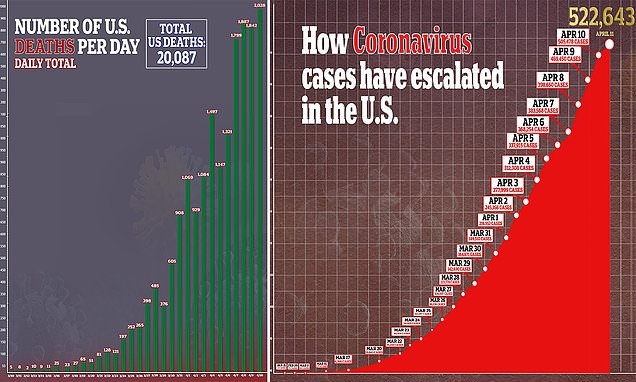
The coronavirus death toll in the United States has surpassed Italy’s today, with more than 20,087 Americans dying from the virus.
Italy has recorded 18,849 deaths as of this afternoon.
The US also yesterday recorded the deadliest day from the coronavirus pandemic any country has so far seen as it becomes the first to mark 2,000 deaths in 24 hours.
In the country’s epicenter, New York , Governor Andrew Cuomo confirmed 783 more people died from the virus yesterday, bringing the death toll in the state to 8,627.
Althought the number of deaths was ‘stabilizing’, it was ‘stabilizing at an horrific rate’, Cuomo said.
According to the latest figures, 508,791 Americans have now tested positive for COVID-19.
As of this afternoon, there were more than 2,700 new cases compared to the day before.
The number of fatalities recorded on Friday was 570, down from 610 the previous day, while the number of new cases slowed to 3,951 from 4,204 the day before.
The latest tallies broadly confirm what experts describe as a plateau of new cases and deaths, which are no longer accelerating but are still not falling steeply.
The total death toll since the outbreak came to light on February 21 rose to 18,849, the Civil Protection Agency said, which before Saturday was the highest in the world.
The number of officially confirmed cases climbed to 147,577, the third highest global tally behind those of the United States and Spain.
With the New York metropolitan swamped with cases, fear mounted over the spread of the virus into the nation’s heartland.
Twenty-four residents of an Indiana nursing home hit by COVID-19 have died.
Chicago’s Cook County has set up a temporary morgue that can take more than 2,000 bodies.
And Chicago Mayor Lori Lightfoot has been going around telling groups of people to ‘break it up.’
As the coronavirus tightens its grip across the country, it is cutting a particularly devastating swath through an already vulnerable population — African Americans.
Democratic lawmakers and community leaders in cities hard-hit by the pandemic have been sounding the alarm over what they see as a disturbing trend of the virus killing African Americans at a higher rate, along with a lack of overall information about the race of victims as the nation’s death toll mounts.
Among the cities where black residents have been hard-hit: New York, Detroit, New Orleans, Chicago and Milwaukee.
A history of systemic racism and inequity in access to health care and economic opportunity has made many African Americans far more vulnerable to the virus.
Black adults suffer from higher rates of obesity, diabetes and asthma, which make them more susceptible, and also are more likely to be uninsured.
They also often report that medical professionals take their ailments less seriously when they seek treatment.
‘The rate at which black people are dying, compared to whites, is really just astounding,’ said Courtney Cogburn, an associate professor at the Columbia University School of Social Work.
‘There are patterns at this intersection of race and socioeconomic status that make it very clear this is just not a story about poverty.’
The pandemic’s center of gravity has long since shifted from China to Europe and the United States, which now has by far the largest number of confirmed cases, with more than half a million.
About half the deaths in the United States were in the New York metropolitan area, where hospitalizations were nevertheless slowing down and other indicators suggested social distancing is ‘flattening the curve’ of infections.
But with authorities warning that the crisis in New York is far from the over, the city announced that its 1.1 million-student school system will remain closed for the rest of the academic year.
At the end of a week officials had warned would be this generation’s Pearl Harbor, White House officials pointed to hopeful signs Friday that the spread of the coronavirus could be slowing, even as President Trump insisted he would not move to reopen the country until it is safe.
At the same time, Trump said he would be announcing the launch of what he dubbed the ‘Opening our Country’ task force next Tuesday to work toward that goal.
With the economy reeling and job losses soaring, Trump has been itching to reopen the country, drawing alarm from health experts who warn that doing so too quickly could spark a deadly resurgence that could undermine current distancing efforts.
But Trump, who had once set Easter Sunday as the date he hoped people in certain parts of the country might begin to return to work and pack church pews, said he would continue to listen to health experts like Drs. Anthony Fauci and Deborah Birx as he considers what he described as the ‘biggest decision I’ve ever had to make.’