
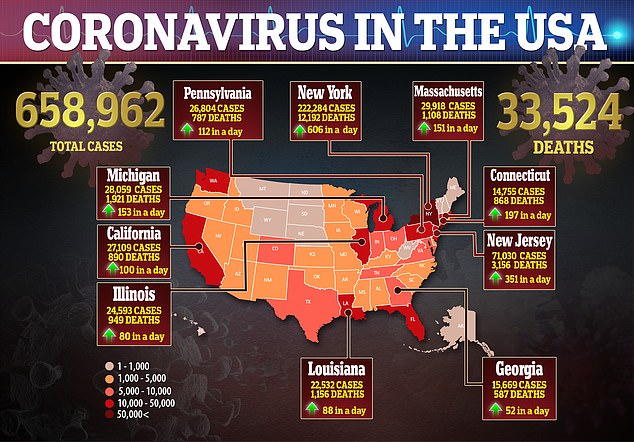
The daily death toll in the United States has set yet another grim record after more than 2,500 fatalities were recorded in a day – the highest yet amid the coronavirus pandemic.
Another 2,524 Americans died of coronavirus in 24 hours, bringing the death toll in the country to more than 33,500.
The record number of deaths comes days after a statistical model relied on by the White House projected that the peak death day would be Monday with 2,150 fatalities.
The number of coronavirus infections across the US has increased by 30,550, bringing the total to 658,962 cases.
Experts view deaths as a ‘trailing indicator’ that continues to increase for several days even if new cases and hospitalizations decline – as people who were hospitalized days or weeks ago continue to pass away.
The statistical model from the University of Washington’s Institute for Health Metrics and Evaluation predicted this week that the total US deaths in the pandemic could reach about 68,800 by early August.
It suggests the US has not yet hit the halfway point for potential fatalities.
New York, which remains the epicenter of the US outbreak, has recorded a decrease in its daily death toll. There were 606 deaths in 24 hours, bringing the total to more than 12,100.
The number of infections in hard-hit New York have increased to 222,000.
New York Governor Andrew Cuomo has extended the state’s lockdown by two weeks until May 15.
Cuomo said today that while the rate of hospitalizations in New York is decreasing, it was still unclear how many people have actually been infected with COVID-19.
He said the unknown tally of infections is what is stopping him from reopening the economy because if people who don’t know they are infected return to work, they risk infecting countless others and wiping out all the progress that has been made.
Cuomo, who has emerged as a leading national voice on the pandemic, said the improvement in key metrics reflected social distancing efforts that had brought the infection rate in his state low enough to control the outbreak.
A total of 17,735 people were hospitalized across New York because of COVID-19, down from 18,335 a day earlier and the lowest since April 6, Cuomo said. Intubations and admissions to intensive care units also declined, he said.
‘The good news is it means we can control the virus. We can control the spread,’ Cuomo told a daily briefing. ‘And we did not know for sure that we could do that.’
But Cuomo noted that about 2,000 infected people were newly admitted to hospitals on Wednesday, and that while deaths declined to 606, marking the lowest daily count in more than a week, the toll on his state was still significant.
‘That is still continuing at a really, really tragic rate,’ Cuomo said of the death tally, adding that there were 29 fatalities at nursing homes, which he called ‘ground zero’ in the fight against the virus.
Cuomo said there was room for optimism in how social distancing had lowered the infection rate to 0.9 across New York, meaning one infected person was causing less than one new infection.
President Trump today further backed away from his claim of having ‘total’ authority on when to reopen the country, and told Americans he would ‘allow’ governors to reopen at their discretion.
‘To preserve the health of our citizens we must also preserve the health and functioning of our economy,’ Trump said at the White House.
Even as deaths and infections in the nation continued to rise, the president declared the nation in the ‘process’ of winning the war against the coronavirus, and announced the new phased return toward normalcy.
He said states would make decisions on when to reopen, a turnaround from what he said on Monday.
Trump centered many of his remarks around the grand battle against the ‘invisible’ enemy, which he likes to cast in military terms.
What he steered clear of were precise metrics about when states should reopen, and what yardsticks citizens can look to to see when they might be able to leave their homes and return to work and school.
Trump teased the possibility of some states reopening within days, but didn’t specify which ones. He has said repeatedly that large western states without dense populations should not be subjected to nationwide lock-downs.
The new guidelines say a state can move toward Phase One when it experiences a ‘sustained decrease’ in infections over a period of 14 days, the period of time during which an infected person is most likely to further spread the disease.
But a state could still be experiencing serious public health problems even while on a downward slope.
Trump again pointed to the economy, and the dangers a closed former powerhouse poses to the nation.
‘We took the greatest economy in the history of the world and we closed it in order to win this war, and we’re in the process of winning it now,’ the president declared.
‘We are starting the rejuvenation of our economy again,’ he said, a day after recent new unemployment claims hit 20 million.
The White House chose a name for the three-phase program that echoes Trump’s Make America Great Again campaign slogan, even as he appeals for bipartisan cooperation.
‘Which we are calling [it] “Opening up America Again.” And that’s what we are doing. We are opening up our country,’ Trump said.
Dr. Anthony Fauci called the three-phase guidelines ‘a rather robust program for reentering into normality.’
He said the ‘dominating drive of this was to make sure that this was done in the safest way possible.’